
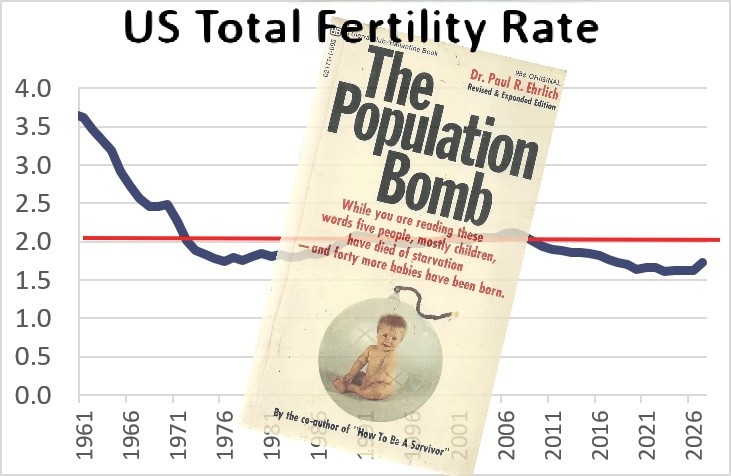
The 1968 best seller “The Population Bomb” warned that the worldwide population had irreversibly outgrown the earth’s ability to produce enough food to sustain its 3.5 billion inhabitants. Author Paul Ehrlich confidently forecast that overpopulation would cause hundreds of millions of deaths in the 1970s and force food rationing in the U.S. by the 1980s.
I’m guessing that Knox County Schools Superintendent Dr. Jon Rysewyk probably doesn’t wish those dire predictions had materialized, but he might prefer that Ehrlich had not been so wildly incorrect.
When Dr. Rysewyk warned that the Knox County system expects enrollment to decline about 900 students this fall, he quickly (and correctly) noted there is no data linking the drop to Tennessee’s universal school choice program. Relative (and now absolute) declines in the school-age population long predate Tennessee’s Education Freedom Scholarship Program—and extend well beyond Knox County.
For the past 15 years, fertility rates in the U.S. have remained below the level needed to maintain a stable population. In 2025, the total fertility rate (TFR) in the U.S. was 1.76. (TFR is the average number of children a woman is expected to have over her lifetime. A TFR of approximately 2.1 is needed for a population to replenish itself from one generation to the next.)
After hovering around 2.0 from 1990 to 2010, the U.S. fertility rate began declining in 2011. Tennessee’s TFR, most recently 1.73, has generally mirrored the national trend.
This demographic shift is evident at the local level.
In the past ten years, Knox County’s population has increased by about 60,000, while school system enrollment slightly declined. This matches a broader national pattern. During the past decade, the percentage of Americans under the age of 18 has declined from 23% to 21%. In 1968, the figure was 35%.
The earth’s population has more than doubled since 1968, yet famine-related mortality has plummeted. In fact, the leading cause of worldwide famine mortality today is war, not natural food shortages. Food production has increased at twice the rate of worldwide population growth, while the share of income needed to purchase food has fallen dramatically.
I don’t think it’s a coincidence that Ehrlich’s book was so popular in 1968, only 4 years before U.S. fertility rates dropped to replacement level, creating a new ceiling, below which they have remained for more than half a century. It is often easiest to whip people into an emotional frenzy near life’s self-correcting inflection points.
Today, fearmongers warn of a coming population shortage. Perhaps I’m being naïve, but I suspect that problem, too, will self-correct, some time before the birth rate drops to zero.
But it probably won’t happen quickly enough for Dr. Rysewyk.
David Moon is president of Moon Capital Management. A version of this piece originally appeared in the USA TODAY NETWORK.